
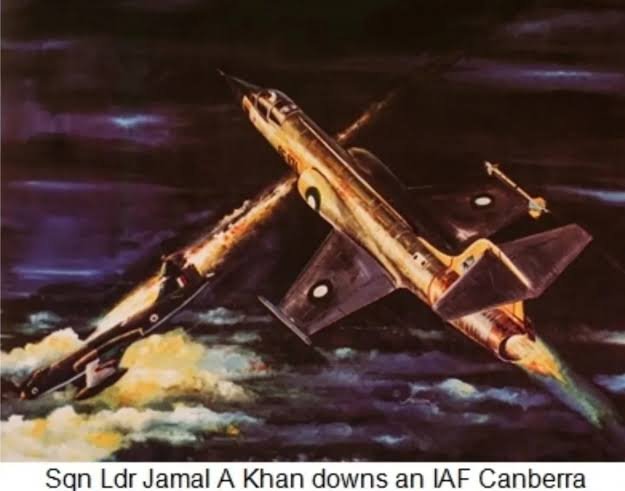
"Blazing the midnight skies ... 21st september 1965On this day, squardon leader Jamal ahmad khan of No. 9 squardon 'Griffins' from Sargodha etched the PAF into global aviation history with the first ever F-104 starfighter missile kill at night !Pursuing the fleeing IAF canbera bomber at 32,000 feet, darkness met its match. Sqn Ldr Jamal A. Khan being guided by FPS-20 GCI at Sakesar, locked on, fired AIM-9B sidewinder missile in a pitched dark night. IF-970 B(i) 58 Canbera of Agra based No.5 squardon 'Tuskers' crashed near international boundary in Fazilka sector. Flt Lt Manmohan Lowe (pilot) ejected and was taken prisoner of war by Pak Army. Flg officer k.k kapur (navigator) could not bail out and perished with the aircraft.It was the only successful night time interception of any aircraft by either side in 65 war + only loss of canbera bomber in the air (other 4 were destroyed on ground at Kalaikunda AFS in west bengal)... that hunter killer pilot rose to of PAF as Air Chief Marshal Jamal A. Khan (march 1985-march 1988)"
The night of September 21, 1965, marked a significant milestone in aviation history as Squadron Leader Jamal Ahmad Khan of the Pakistan Air Force (PAF) accomplished the first-ever nighttime missile kill using an F-104 Starfighter. Engaged in the Second India-Pakistan war, this achievement showcased not only technical prowess but also the strategic capabilities of the PAF.
Operating from Sargodha, Squadron Leader Khan was guided by the FPS-20 Ground Controlled Interception (GCI) system, which was pivotal during this high-stakes mission. Pursuing an Indian Air Force (IAF) Canberra bomber flying at 32,000 feet, Khan's engagement exemplified the discipline and skill of PAF pilots. Utilizing the AIM-9B Sidewinder missile, he successfully shot down the aircraft, marking the only successful nighttime interception of this conflict.
This unprecedented event captured the attention of military analysts and international observers alike. The successful interception elevated Pakistan's standing in military aviation, showcasing not just their capabilities but also signaling strategic resilience amid the geopolitical tensions. While both nations experienced significant losses during the conflict, the PAF's success represented a morale boost for Pakistan, solidifying the country's aviation legacy on a global scale.
As the PAF honors the legacy of heroes like Jamal Ahmad Khan, their journey continues in the realm of modern defense. The lessons learned from such historic moments guide contemporary military strategies and training for future generations. As Pakistan advances in aviation technology and military expertise, the focus remains on fostering peace and stability in the region while celebrating the bravery of its air force. The remembrance of this great feat serves not only as a testament to PAF capabilities but also as an invitation for dialogue and cooperation in a rapidly changing world.


No comments yet. Be the first to comment!