
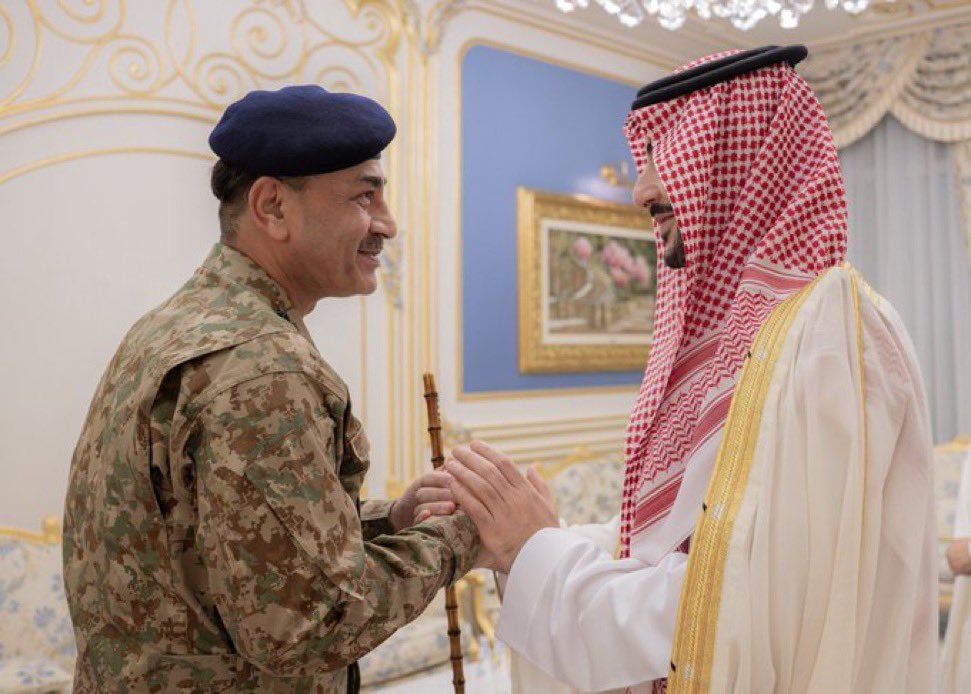
"HRH Khalid bin Salman bin Abdulaziz, Minister of Defence, Kingdom of Saudi Arabia met Field Marshal Syed Asim Munir, NI (M), HJ, Chief of Army Staff and Chief of Defence Forces (COAS & CDF) of Pakistan During the meeting, there was praise for the outcomes of the meeting of Chiefs of Staff of the countries of the Mecca Joint Defence Agreement, and discussion of the attacks that targeted Makkah al-Mukarramah and civilian and economic facilities in the Kingdom, with emphasis on continuing joint efforts to confront these attacks in accordance with the Makkah Joint Defence Agreement for Joint Defense.The meeting was attended by His Excellency the Minister of State, Member of the Council of Ministers, National Security Advisor Dr. Musaed bin Mohammed Al-Oyayari; His Excellency the Chief of the General Staff, Lieutenant General Fayyadh bin Hamed Al-Ruwaili; and His Excellency the Advisor to His Royal Highness the Minister of Defense for Intelligence Affairs, Professor Hisham bin Abdulaziz bin Saif.COAS & CDF was accompanied by a delegation."
In a significant meeting, HRH Khalid bin Salman bin Abdulaziz, the Saudi Minister of Defence, engaged with Field Marshal Syed Asim Munir, the Chief of Army Staff and Chief of Defence Forces of Pakistan. This dialogue highlighted both nations' commitment to fortifying their defense collaboration, especially in light of recent regional threats and existing agreements.
The discussions centered around the outcomes of the Mecca Joint Defence Agreement, showcasing mutual recognition of the necessity for collective security measures. Notably, the talks addressed attacks on Makkah al-Mukarramah and essential civilian and economic sites in Saudi Arabia. Both nations reiterated their commitment to continuing joint efforts to mitigate such threats, underlining the significance of proactive defense strategies to safeguard their citizens and national interests.
The dialogue between Saudi Arabia and Pakistan has garnered attention from the international community, showcasing a model for cooperative security in a volatile region. Other countries observing these developments may find inspiration in this partnership, signaling a collaborative approach to defense and security that prioritizes regional stability. With growing threats from both state and non-state actors, such alliances could play a crucial role in crafting a unified front against adversarial forces.
The future of Saudi-Pakistani relations looks promising, especially in the area of defense cooperation. As both nations navigate complex geopolitical landscapes, their reinforced ties could lead to enhanced training programs, intelligence sharing, and collaborative military exercises. These initiatives not only bolster their defensive posture but also contribute to broader regional security initiatives. The commitment to the Makkah Joint Defence Agreement could serve as a cornerstone for a more secure South Asia, riding on the back of collective efforts against shared threats.


No comments yet. Be the first to comment!